Forex trading can be an unfamiliar subject for someone starting from zero. Before opening an account or depositing money, it helps to understand how accounts work, what documents may be required, which platforms are available, and how demo trading can be used to build familiarity with the market.
How to Start Forex Trading in Malaysia
Opening a forex trading account in Malaysia involves choosing a broker, verifying your identity, and funding your account. Because local retail options directly through Bursa Malaysia are primarily for equities and derivatives, most Malaysian forex traders use reputable international brokers that accept Malaysian clients.
Step 1: Choose a Regulated Broker
- Regulatory Check: Ensure the broker is regulated by reputable international tiers (such as the FCA in the UK, ASIC in Australia, or MAS in Singapore) or holds a Capital Markets Services Licence (CMSL) from the Securities Commission Malaysia (SC) if trading locally.
- Key Factors to Compare: Look at spreads, leverage limits, deposit/withdrawal methods, and platform availability (e.g., MetaTrader 4/5, cTrader, or proprietary apps).
For additional broker research, you can explore our guide to the best forex brokers in Malaysia.
Step 2: Prepare Required Documents
To comply with standard Know Your Customer (KYC) regulations, you will typically need to submit digital copies of:
- Proof of Identity: A valid Malaysian MyKad (for citizens) or a valid Passport.
- Proof of Address: A recent utility bill, bank statement, or telecommunication bill showing your current residential address matching your application (usually dated within the last 3 to 6 months).
Step 3: Complete the Online Application
- Visit the official website or download the mobile app of your chosen broker.
- Fill out the application form with your personal details, employment status, annual income, and financial background/risk tolerance questionnaire.
- Select your account type (e.g., Standard, Raw/ECN spread) and base currency (commonly USD, SGD, or EUR, as many international brokers do not maintain direct MYR-denominated forex wallets).
Step 4: Identity Verification (KYC)
- Upload clear photos of your MyKad/Passport and your proof of address document.
- Many platforms use automated biometric verification, meaning account approval can take anywhere from a few minutes to 24 business hours.
Step 5: Fund Your Account
- Once approved, log into your client portal and navigate to the deposit section.
- Fund your account using supported payment methods, which usually include online bank transfers (FPX or local bank wiring options provided by the broker), credit/debit cards, or e-wallets.
Important Note: While retail forex trading is legal for individuals in Malaysia, make sure to deal only with authorized or reputable financial entities to protect your capital against unauthorized operations.
You can also read our detailed guide on whether forex trading is legal in Malaysia.
Choosing the Right Forex Trading Account
Choosing the right forex trading account depends heavily on your capital, trading experience, strategy, and personal convictions. Brokers typically categorize accounts by lot size/capital requirements, fee structures, and special features.
The primary types of forex trading accounts are compared below:
Comparison of Forex Trading Account Types
| Account Type | Target Audience | Minimum Deposit | Lot / Contract Size | Cost Structure | Key Advantage / Drawback |
|---|---|---|---|---|---|
| Demo Account | Beginners / Strategy testing | Free (Virtual funds) | Variable | None | Adv: Zero financial risk. |
| Cent / Micro Account | Beginners with very small capital | Very low ($1 to $10) | Cent lots or Micro lots (1,000 units) | Built-in spread | Adv: Real-money trading with minimal risk exposure. |
| Standard Account | Intermediate / General traders | Moderate ($10 to $100+) | Standard lot (100,000 units) | Built-in spread (No commission) | Adv: Simple, predictable pricing; easy to track costs. |
| ECN / Raw Spread Account | Advanced traders / Scalpers | Higher ($100 to $200+) | Standard lot (100,000 units) | Raw interbank spreads (~0 pips) + fixed commission per lot | Adv: Lowest overall trading costs for high volume. |
| Islamic (Swap-Free) Account | Traders seeking Sharia compliance | Varies (Applied to base account) | Depends on base account type | Spread/Commission + alternative admin fees | Adv: No overnight interest (swaps) accrued. |
| Managed Account (PAMM/MAM) | Investors seeking passive income | Higher ($500 to $1,000+) | Managed by a professional trader | Performance fees / Management fees taken by the manager | Adv: No active trading required. |
For a more MetaTrader 4 in Malaysia guide, see our guide to MetaTrader 4 Malaysia
Key Takeaways for Choosing
- If you are a complete beginner: Start with a Demo account to learn platform mechanics, then transition to a Cent or Micro account to experience real-money market psychology without risking significant capital.
- If you trade casually or part-time: A Standard account offers the simplest structure, letting you manage trades without calculating separate commissions.
- If you are a high-frequency day trader or scalper: An ECN / Raw account is usually more cost-effective because tighter spreads save money on frequent entries and exits, despite the flat commission.
The account comparison above shows why beginners should consider more than the minimum deposit. Account structure, lot size, pricing, and the intended use of the account can all affect the trading experience.
If Islamic or swap-free trading is relevant to your requirements, you can also explore Islamic forex trading in Malaysia.
Forex Demo Accounts for Malaysian Beginners
Several international forex brokers heavily cater to traders in Malaysia and provide free demo trading accounts. These demo accounts allow you to practice trading using virtual funds on live market data.
Popular Forex Brokers with Demo Accounts in Malaysia
| Broker | Key Highlight for Malaysian Traders | Demo Account Features |
|---|---|---|
| Exness | Supports local FPX online banking for easy MYR deposits/withdrawals. | Free, unlimited duration, customizable virtual balance. |
| IC Markets | Well-known for high-speed execution and tight spreads. | Free demo available on MetaTrader 4, MetaTrader 5, and cTrader. |
| FBS | Popular among beginners with accessible cent accounts and local support. | Free demo account with adjustable virtual funds. |
| Tickmill | Offers transparent pricing structures and low-cost execution. | Free demo accounts compatible with MT4/MT5. |
Read : MetaTrader 4 vs MetaTrader 5
Important Considerations
- Regulation Notice: While these brokers freely accept clients from Malaysia, they are typically regulated offshore (e.g., by the FSA, FSC, or CySEC) rather than directly by the Securities Commission Malaysia (SC), as the SC maintains a cautious stance on retail online forex trading.
- Islamic Accounts: If you plan to transition to a live account later, ensure the broker also offers swap-free (Islamic) account options to align with Sharia requirements.
A demo account gives beginners an opportunity to become familiar with the mechanics of trading before moving to a live environment. It can be particularly useful for learning how a platform handles orders, charts, account balances, and trading tools.
You can also build your knowledge with our guide to essential forex terminology every beginner should know.
Online Trading Platforms in Malaysia
Online trading platforms in Malaysia vary significantly based on fees, asset classes, and whether you want to focus on local markets (Bursa Malaysia) or global exchanges (like the US or Hong Kong).
Comparison of Popular Online Trading Platforms in Malaysia
| Platform | Markets Available | Min. Deposit | Typical Brokerage Fees | Key Highlights |
|---|---|---|---|---|
| Rakuten Trade | Malaysia, US, HK | RM0 | MY: From RM1 (up to 0.10%) | Joint venture between Kenanga Investment Bank and Japan’s Rakuten. Popular for local trading with low entry barriers and Cash Upfront/Contra accounts. |
| Moomoo (MY) | Malaysia, US, HK | RM0 | Varies (frequent promotional 0% commission structures; platform fees apply) | Advanced analytical tools, real-time depth data, and robust educational resources. Includes built-in Shariah screening filters. |
| Webull (MY) | Malaysia, US | RM0 | Low commission models (e.g., ~0.025% for US) | Clean UI, robust technical analysis charting features, targeted toward tech-savvy retail investors. |
| M+ Global | Malaysia, US, HK | RM100 | ~0.10% for global markets | Backed by Malacca Securities; offers seamless transition between local CDS accounts and foreign trading access. |
| Interactive Brokers (IBKR) | Global (150+ markets, including Bursa Malaysia) | $0 (USD) | Tiered or fixed commission (e.g., min $2 per trade) | Built for advanced/professional investors; deep liquidity, multi-currency accounts, and access to complex instruments (options, futures). |
Read: Best Options Trading Platforms in Gauteng
Key Factors to Consider
- Regulatory Compliance: Ensure the platform is either directly licensed by the Securities Commission Malaysia (SC) (such as local brokerages and digital investment participants) or operates through globally recognized Tier-1 regulatory frameworks if dealing with multi-asset international brokers.
- Shariah Compliance: If you require Islamic-compliant investments, platforms like Moomoo and Webull feature built-in Shariah screening indicators to filter compliant counters on Bursa and global exchanges.
- Hidden Costs: Look past “zero commission” marketing to check currency conversion (FX) spreads for global trading, clearing fees, and local stamp duty charges (e.g., Bursa Malaysia charges a 0.1% stamp duty on share transfers).
One important distinction for beginners is the difference between a broker and a trading platform. A broker provides access to financial markets and account services, while a platform is the software or interface used to analyze markets and place trades.
For a more forex-focused comparison, see our guide to the best forex trading platforms in Malaysia.
Learning Platforms for Beginners in Malaysia
Whether you are looking to pick up a new career skill, learn coding, or dive into digital marketing, Malaysia has a robust selection of online learning platforms tailored for beginners.
The top-rated online platforms available for beginners in Malaysia include:
1. Local & Government-Backed Platforms
- e-LATiH (HRD Corp): Malaysia’s premier national learning hub provides thousands of free or subsidized courses ranging from digital technology and leadership to finance. It is user-friendly and built specifically to upskill the local workforce.
- Malaysia MOOC (OpenLearning): Developed in collaboration with the Ministry of Higher Education and local public universities (like UM, UTM, and USM), this platform offers structured, beginner-friendly courses across multiple disciplines designed for the local context.
- Rakyat Digital: An initiative focused on boosting digital literacy and essential everyday tech skills for Malaysians, offering free tools and beginner guides.
Read: Forex Trading Account Beginner’s Guide for Malaysians
2. Global Platforms with Local Relevance
- Coursera / edX: Partnering with top global universities and local institutions like Universiti Malaya, these platforms are great for beginners wanting structured guidance, starting from zero-level fundamentals up to professional certificates.
- Google Digital Garage: Ideal for absolute beginners stepping into the tech or business space. It offers free, highly recognized certifications in foundational areas like Digital Marketing, Data Analytics, and IT Support.
3. Skill-Specific & Alternative Platforms
- Udemy: While paid, Udemy frequently runs massive discounts. It is one of the best catalogues for absolute beginners looking for step-by-step video tutorials on coding, graphic design, language learning, or video editing.
- LinkedIn Learning: Great for career-focused beginners looking to blend technical skills with professional soft skills, often accessible for free through certain public library memberships or corporate subscriptions.
For a detailed guide, read forex risk management for beginners.
Tips for Beginners Getting Started
- Check for Subsidies: If you are a working professional in Malaysia, check if your employer contributes to HRD Corp, as many premium courses on platforms like e-LATiH can be claimed or accessed at zero cost.
- Start with Short Courses: Avoid burning out by choosing micro-credentials or short 2-to-4-week courses before committing to a full certificate program.
A beginner can make the learning process more manageable by progressing from basic concepts to practical application. Start by learning forex terminology, then understand account structures and trading platforms. After that, use a demo account to become familiar with the mechanics before considering live trading.
Read: Options Trading in South Africa
Forex Risk Management for Beginners
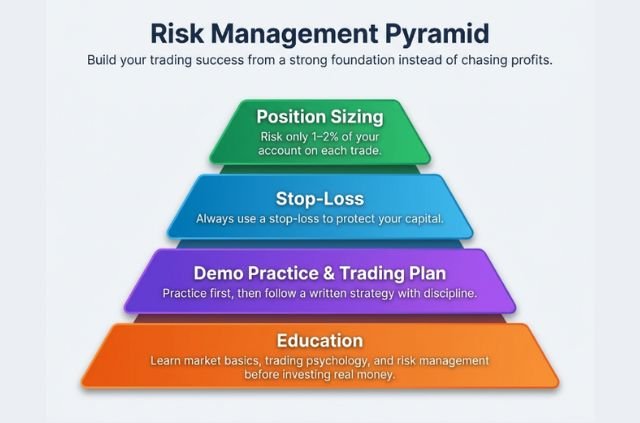
Risk management should be an important part of any beginner’s learning process. Understanding how much capital is exposed to a trade and having a structured approach to managing potential losses can help create a more disciplined trading process.
Understanding Forex Trading Hours in Malaysia
Forex market activity can vary depending on the global trading session and the currency pairs being traded. Understanding when major sessions are active can help beginners organize their research and trading schedule.
Learn more in our guide to forex trading hours in Malaysia.
A Simple Forex Learning Path for Beginners
A structured approach can make forex education easier:
- Learn the basic forex terminology.
- Understand how trading accounts work.
- Compare brokers and trading platforms.
- Practice with a demo account.
- Learn the basics of risk management.
- Understand trading costs.
- Create a structured approach before considering live trading.
- Continue learning and reviewing your progress.
Forex trading for beginners in Malaysia involves more than simply opening an account. Understanding account types, broker selection, trading platforms, demo accounts, and risk management can help beginners build a stronger foundation.
Before moving forward, continue exploring related topics such as How to Start Forex Trading in Malaysia, Forex Trading Taxes in Malaysia, MetaTrader 4 vs 5, Options Trading in Malaysia: Brokers, Tax Guide