Options trading involves financial contracts that give the buyer the right, but not the obligation, to buy or sell an underlying asset at a set price within a specific timeframe. In Malaysia, options can be traded through global brokers accessing international markets like the US or locally via Bursa Malaysia Derivatives (BMD), which offers options on futures contracts such as the FTSE Bursa Malaysia KLCI Futures (OKLI) and Crude Palm Oil Futures (OCPO).
For investors who are new to derivatives, understanding how options work is only the beginning. Choosing an appropriate broker, understanding currency conversion, managing risk and knowing how trading activity may be treated for Malaysian tax purposes are equally important.
Understanding Options Trading in Malaysia
Before choosing a platform or placing an options trade, every Malaysian trader should understand the fundamental components of an options contract.
1. Core Contract Components
- Underlying Asset: The financial instrument the option contract is tied to, such as a specific stock, index futures, or commodity futures.
- Strike Price: The fixed, predetermined price at which the underlying asset can be bought or sold if the option is exercised.
- Premium: The upfront cost or price paid by the option buyer to the seller for the contract.
- Expiration Date: The deadline date when the contract expires; after this, the option becomes worthless if unused. Options traded on Bursa Malaysia are typically European-style, meaning they can only be exercised on the expiration date.
If you are still learning the language of derivatives, understanding basic forex and trading terminology can also make financial-market concepts easier to follow.
2. The Two Main Types of Options
- Call Options: Give the buyer the right to buy the underlying asset at the strike price. Traders buy calls if they expect the market or asset price to rise with a bullish outlook.
- Put Options: Give the buyer the right to sell the underlying asset at the strike price. Traders buy puts if they expect the asset price to fall with a bearish outlook or want to hedge an existing portfolio against a downturn.
3. Buyers vs. Sellers: Holders vs. Writers
- Option Buyers (Holders): Pay the premium. Their risk is strictly limited to the amount paid for the premium, but they have the flexibility to profit from sharp market moves.
- Option Sellers (Writers): Collect the premium upfront. However, they take on the obligation to fulfill the trade if the market moves against them, which can expose them to substantial or even unlimited risk depending on the strategy.
This difference is important because selling options is not simply the opposite of buying them. The potential obligations, margin requirements and risk profile can be substantially different.
Read: Forex Trading Account Beginner’s Guide for Malaysians
4. Option “Moneyness”
Options are commonly described according to their relationship with the current price of the underlying asset.
- In-The-Money (ITM): An option that has intrinsic value because the strike price is favorable relative to the current market price of the underlying asset.
- At-The-Money (ATM): An option where the strike price is equal to or very close to the current market price.
- Out-of-The-Money (OTM): An option with no intrinsic value, where exercising it would currently make no financial sense.
5. Key Risk Factors
Options can provide leverage, but leverage can increase losses as well as potential returns.
- Time Decay (Theta): Options lose value as they get closer to their expiration date, even if the underlying asset’s price doesn’t change much.
- Volatility: Changes in market volatility heavily impact an option’s premium. Higher volatility generally increases option prices.
- Leverage: Options allow traders to control a large amount of an asset with a relatively small amount of capital, which can amplify both potential profits and losses.
For traders who want a broader foundation in risk control, the forex risk management guide for beginners provides additional context on managing exposure and protecting trading capital.
How to Choose a Regulated Options Broker in Malaysia
Choosing a regulated broker for options trading, such as US equity options or global derivatives, from Malaysia requires balancing local legal protection, platform capabilities, and cost efficiency.
Because local retail options trading on Bursa Malaysia is limited compared to global markets, many Malaysian options traders access international exchanges through globally trusted brokers that comply with local guidelines or hold international tier-1 licenses.
1. Verify Regulatory Standing
- Securities Commission Malaysia (SC): Check if the broker holds a Capital Markets Services License (CMSL) from the SC.
- Tier-1 International Regulators: If you use a global broker such as Interactive Brokers, ensure they are heavily regulated by top-tier bodies like the US SEC/FINRA, FCA (UK), or ASIC (Australia).
- Avoid the SC Investor Alert List: Always cross-reference the broker against the SC’s Investor Alert List to ensure they are not operating illegally or blacklisted in Malaysia.
The SC’s Investor Alert List is particularly important because the regulator states that the list contains unauthorised entities and individuals and warns that investors dealing with unauthorised parties may not receive protection under Malaysian securities laws.
Before opening an account, Malaysian investors should therefore verify the broker’s regulatory status rather than relying only on advertisements, social media recommendations or claims made on a broker’s website.
If you are comparing platforms specifically for Malaysian traders, see this guide to the best forex trading platforms in Malaysia.
2. Evaluate Market and Product Access
- Underlying Assets: Determine whether you want to trade US stock options such as Apple or Tesla, index options such as SPX or NDX, or local derivatives. Make sure the broker provides direct market access (DMA) to major exchanges like the CBOE or OCC.
- Contract Types: Check if they support basic options such as calls and puts as well as multi-leg advanced strategies such as spreads, straddles and iron condors depending on your trading experience.
Market access should match your actual trading objective. A platform that offers hundreds of instruments is not automatically better if the products you need are unavailable or if the account does not support the strategy you intend to use.
3. Compare Fees and Commissions
Options trading involves several layers of costs that can eat into profitability.
- Contract Fees: Look for low per-contract clearing and commission fees, such as flat rates per contract or commission-free structures up to a specific monthly tier.
- Exchange/Regulatory Fees: Understand pass-through fees charged by US exchanges.
- Currency Conversion Costs: Since most global options are priced in USD, check the platform’s FX conversion spreads and deposit/withdrawal fees via Malaysian bank accounts such as FPX or telegraphic transfers.
A broker with a low headline commission can still be expensive if its currency conversion spread, data fees, exchange charges or other account costs are high.
4. Assess Trading Tools and Platform Reliability
- Data Feeds: Options trading requires real-time pricing, Greeks such as Delta, Theta, Gamma and Vega, and implied volatility data. Ensure the broker provides these either for free or at a low subscription cost.
- Margin Requirements: If you plan to trade vertical spreads or write options, review their margin policies, collateral requirements and interest rates for borrowing.
Platform reliability also matters. Options markets can move quickly, so delayed market data, limited order types or poor execution tools can materially affect how a strategy performs.
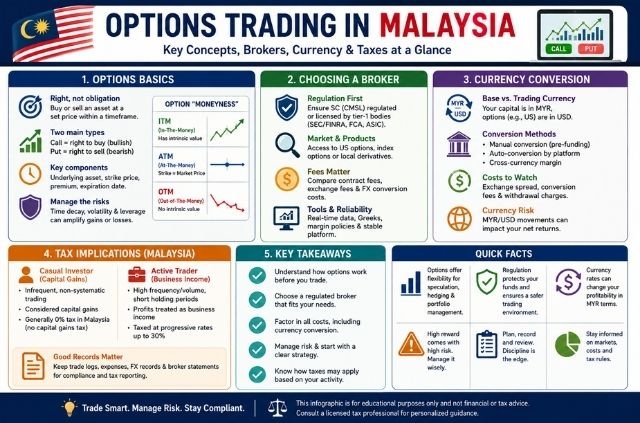
Currency Conversion When Trading International Options From Malaysia
When trading international options from Malaysia, such as options on US stocks traded in USD, currency conversion is a fundamental part of the process because your local capital is typically in Malaysian Ringgit (MYR), while the derivatives are denominated in a foreign currency.
Here is a breakdown of how currency conversion generally works for international trading platforms accessible from Malaysia.
1. Base Currency vs. Trading Currency
- Account Currency: When you open an international brokerage account or use a local platform offering global market access, your base cash balance might be held in MYR, or you may need to deposit and hold foreign currencies like US Dollars (USD).
- Contract Denomination: International options, such as US equity options, are priced, bought and settled in USD. Every premium you pay to open a contract and every payout from closing one is denominated in USD.
This means a Malaysian trader needs to consider both the performance of the option and the movement of the MYR/USD exchange rate.
2. Conversion Methods Used by Brokerages
Depending on the broker you use, currency conversion usually happens in one of a few ways:
- Manual Conversion (Pre-funding): You explicitly convert your MYR into USD within your brokerage app before placing a trade. Once converted, your USD balance is used to buy the options contract.
- Auto-Conversion / Cross-Currency Trading: Many modern multi-currency platforms allow you to place trades directly using your MYR cash. If you buy a USD-denominated option, the system automatically calculates the equivalent MYR amount, executes the trade and performs the currency conversion either instantly or during settlement.
- Cross-Currency Margin: Some advanced brokerages allow margin accounts to leverage MYR buying power to trade foreign securities, converting the borrowed amounts after the market closes or upon trade settlement.
The exact process depends on the brokerage, account type and product being traded, so investors should review the platform’s current currency and settlement rules before placing an order.
3. Settlement and Timing
Options trades typically settle on a T+1 basis, meaning one business day after the trade date.
- The actual currency exchange rate applied to your transaction is locked in either at the exact moment of order execution or during the official processing window.
- Until the trade fully settles, your account statement may show pending currency exchanges or a temporary “currency mix” breakdown.
4. Costs and Exchange Rates
Keep in mind that currency conversion is never entirely free.
- Exchange Spread: Brokers and financial institutions use a live market rate, or spot rate, but add a markup or spread.
- Conversion Fees: Some platforms charge a small explicit fee or commission per currency conversion transaction unless you use a multi-currency feature with transparent tier pricing.
A small difference in the conversion rate can become meaningful when larger amounts are converted repeatedly. For this reason, Malaysian traders should evaluate FX costs alongside commissions when comparing international options brokers.
5. Currency Risk (FX Risk)
Beyond conversion fees, fluctuating exchange rates between the MYR and the foreign currency directly impact your total returns.
Even if your options trade is profitable in USD, a strengthening Malaysian Ringgit against the USD at the time you convert your profits back to MYR can reduce your overall local currency earnings, and vice versa.
This creates two separate variables in an international options position:
- The performance of the options contract.
- The movement of the currency used to value the trade.
Understanding both is important when evaluating the real return of an international options strategy from Malaysia.
Tax Implications of Options Trading for Malaysian Residents
The tax implications of options trading profits for Malaysian residents depend heavily on intent, frequency and classification rather than a blanket rule, as Malaysia operates on a territorial tax system and generally does not tax standard capital gains.
The Inland Revenue Board of Malaysia (LHDN) evaluates options trading profits under two primary categories.
1. Casual Investor: Capital Gains
If you trade options infrequently as an individual to grow your personal investment portfolio, your profits are typically viewed by LHDN as capital gains.
- Tax Rate: 0%. Malaysia does not have a broad capital gains tax on standard securities or derivatives trading for casual investors.
- Requirements: Your trading activity must be sporadic, non-systematic and not your primary source of livelihood.
The classification of investment profits can depend on the facts and circumstances of the individual’s activity. Investors should therefore maintain records that support the nature and purpose of their trading activity.
2. Active Trader / Business Income
If your options trading behavior resembles a business or trade, LHDN will classify your profits as business income under Section 4(a) of the Income Tax Act 1967.
LHDN applies the “Badges of Trade” framework to determine this, looking at factors such as:
- Frequency and Volume: Executing a high volume of trades daily or weekly.
- Holding Period: Opening and closing options positions rapidly, such as day trading or short-term swing trading.
- Organization: Treating trading like a commercial enterprise, dedicating significant time or using specialized setups.
- Financing: Utilizing leverage or credit explicitly structured for commercial trading.
- Tax Rate: If classified as a trader, your net profits are subject to progressive resident income tax rates, which max out at 30% for high-income earners.
- Deductible Expenses: The upside to being classified as a trader is that you can legally deduct trading-related expenses, such as brokerage commissions, platform fees, internet bills and educational trading courses, from your gross trading profits.
For investors who want to understand the broader tax topic, PipInfuse also covers forex trading taxes in Malaysia.
Geographic Considerations and Foreign Options
Many Malaysian residents trade options on US exchanges, such as CBOE, via international brokers.
- Foreign-Sourced Income Rules: Malaysia’s rules for foreign-sourced income can depend on the type of income, whether it has been taxed in the country of origin and the applicable exemption conditions. Active business profits derived from systematic trading operations managed from Malaysia may still attract scrutiny from LHDN.
- Withholding Taxes: If you trade US options or equities, note that the US Internal Revenue Service (IRS) may impose withholding taxes on certain dividend-equivalent events or specific derivative distributions, governed by the tax treaty between Malaysia and the US.
Because cross-border tax treatment can depend on the specific instrument, source of income and circumstances, investors should not assume that every foreign options profit receives identical tax treatment.
Summary Checklist for LHDN Compliance
- Keep Detailed Records: Maintain clean logs of your trade execution dates, frequency, losses and operational expenses.
- Consistency: Do not flip-flop unpredictably between claiming profits are tax-free capital gains one year and writing off business losses the next.
- Document Currency Transactions: Keep records of MYR/USD conversions, conversion rates, brokerage statements and transfers.
- Keep Broker Statements: Retain trade confirmations and account statements showing premiums, realised gains and losses and fees.
- Separate Trading Records: Keep personal investment activity and any business-related trading activity properly documented.
A Practical Framework for Malaysian Options Traders
The following section is new content added separately to strengthen the article’s search coverage and provide a more practical decision-making framework. It does not replace the core source content above.
How to Start Options Trading in Malaysia
For a beginner, the most sensible approach is to build knowledge before increasing position size. Options combine the direction of the underlying asset with factors such as time to expiration, volatility and the strike price.
A practical starting process looks like this:
Step 1: Learn How Options Work
Understand calls, puts, strike prices, premiums, expiration dates and moneyness before risking capital.
Step 2: Decide Which Market You Want to Trade
Determine whether your focus is Bursa Malaysia derivatives, US equity options, index options or another international derivatives market.
Step 3: Check Broker Regulation
Verify the broker through the relevant regulatory register and check the Securities Commission Malaysia’s Investor Alert List before transferring money.
Step 4: Understand the Full Cost
Calculate commissions, contract fees, exchange fees, data costs, currency conversion spreads and potential financing charges.
Step 5: Understand Your Maximum Risk
Do not evaluate a strategy only by its potential return. Determine how much capital can be lost if the trade moves against you.
Step 6: Start With a Defined Strategy
Beginners should understand the complete payoff structure of a strategy before using advanced multi-leg positions or option-writing strategies.
Step 7: Keep a Trading Journal
Record the reason for entering a position, the strategy used, entry and exit prices, expiration, risk, result and lessons learned.
Options Trading vs. Forex Trading in Malaysia
Options and forex are different markets even though both can be used for speculation and hedging.
Forex trading generally involves buying one currency against another, while an option gives the holder a right to buy or sell an underlying asset at a predetermined price.
The risk drivers also differ. Options traders need to consider factors such as time decay, implied volatility and moneyness. Forex traders may focus more heavily on currency pairs, leverage, spreads, economic releases and market sessions.
If you are comparing the two markets, the guide to forex trading for beginners in Malaysia provides a useful starting point for understanding the forex market.
Why Risk Management Matters in Options Trading
Options can create significant exposure with relatively little initial capital. This makes position sizing especially important.
A trader should consider:
- The maximum amount they are willing to lose.
- Whether the strategy has defined or potentially unlimited risk.
- The amount of margin required.
- How much time remains before expiration.
- How volatility could change the option premium.
- Whether the position is affected by currency movements.
- Whether multiple positions are exposed to the same underlying market factor.
Risk management should be considered before the trade is opened, not after a position begins moving against the trader.
For additional risk-management principles, see the forex risk management guide.
Common Mistakes Malaysian Options Beginners Should Avoid
Several mistakes can make options trading more difficult than necessary.
Ignoring Currency Risk
A profitable USD-denominated trade does not automatically mean the same percentage return when measured in MYR.
Choosing a Broker Based Only on Fees
Low commissions are useful, but regulation, market access, execution quality, data, margin requirements and currency conversion costs also matter.
Trading Complex Strategies Too Early
Multi-leg strategies can be useful, but beginners should understand every leg of a position before using them.
Treating Leverage as Free Buying Power
Leverage increases exposure. It does not remove the underlying risk of the trade.
Ignoring Time Decay
An options buyer can correctly predict the direction of the underlying asset and still lose money if the move is too small or happens too late.
Failing to Keep Records
Detailed records are useful for performance analysis and can also become important when determining the tax treatment of trading activity.
Options trading can provide Malaysian investors with access to international markets and a wide range of strategies for speculation, hedging and portfolio management. However, options are not simply a leveraged version of ordinary share trading.
A complete approach requires an understanding of the contract itself, the broker providing market access, currency conversion, trading costs, risk management and potential tax treatment.
For beginners, the strongest foundation is education and disciplined risk control. Before committing significant capital, understand the strategy, verify the broker, calculate the complete cost and determine the potential downside.
Tax laws regarding digital assets, derivatives and cross-border trading can be complex and subject to individual audit scrutiny by LHDN. It is recommended to consult a licensed Malaysian tax professional or chartered accountant for your specific portfolio structure.