If you are searching for the weakest currencies in the world, here is the direct answer. By official exchange rate, the Lebanese pound is the weakest currency in the world in 2026, trading at roughly 89,500 LBP per US dollar. Using open market rates instead, the Iranian rial takes the top spot, with more than one million rials needed to buy a single dollar. Both currencies tell the same underlying story: years of political instability, sanctions, and inflation that never really eased off.
Currency value is one of the clearest mirrors of a country’s economic health. A weak currency is not just a number on a screen. It reflects inflation, government debt, trade balance, and how much the world trusts a central bank to manage its money supply. Below is where things stand right now, why these currencies fell so far, and what it actually means if you trade forex or simply want to understand global money better.
These figures come from open market and official sources reported between January and March 2026, including Forbes Advisor, Equiti, and Taurex. Exchange rates shift daily, so treat this table as a snapshot rather than a fixed number, and check a live converter before relying on any figure here.
Read: Why XAUUSD Defies the DXY
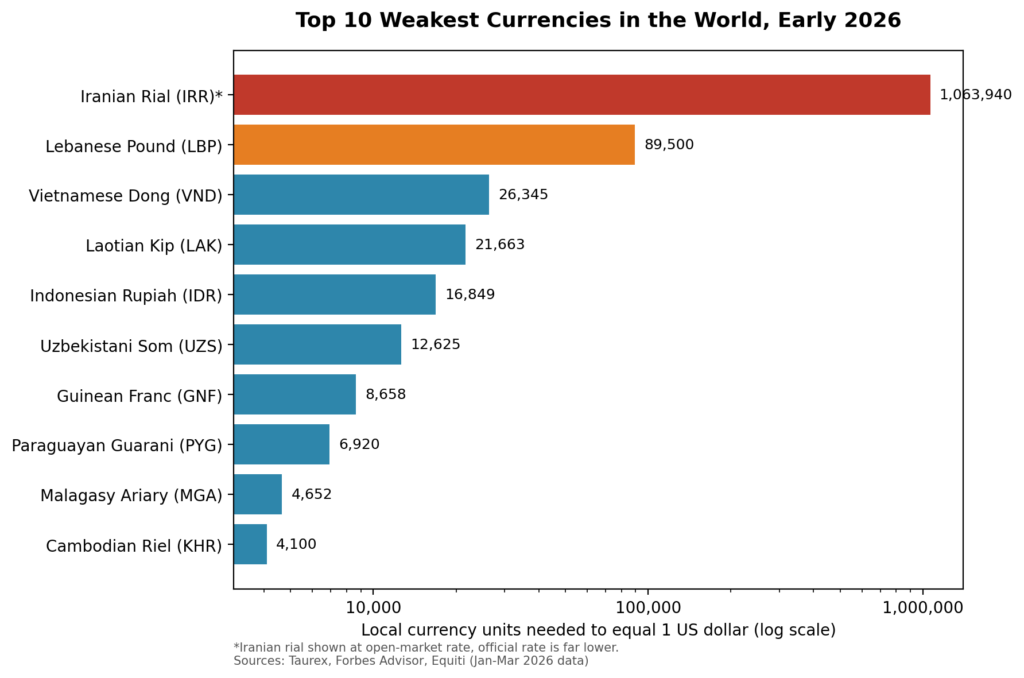
Top 10 Weakest Currencies in the World (2026 Ranking)
| Rank | Currency | Code | Country | Rate vs USD (Approx. Early 2026) |
|---|---|---|---|---|
| 1 | Lebanese Pound | LBP | Lebanon | ~89,500 |
| 2 | Iranian Rial (Open Market) | IRR | Iran | 1,000,000+ |
| 3 | Vietnamese Dong | VND | Vietnam | ~26,345 |
| 4 | Laotian Kip | LAK | Laos | ~21,663 |
| 5 | Indonesian Rupiah | IDR | Indonesia | ~16,849 |
| 6 | Uzbekistani Som | UZS | Uzbekistan | ~12,625 |
| 7 | Guinean Franc | GNF | Guinea | ~8,658 |
| 8 | Paraguayan Guarani | PYG | Paraguay | ~6,920 |
| 9 | Malagasy Ariary | MGA | Madagascar | ~4,652 |
| 10 | Cambodian Riel | KHR | Cambodia | ~4,100 |
Why Are These the Weakest Currencies in the World Right Now
No currency lands at the bottom of the list by accident. A mix of these forces is usually at work:
- Inflation. When a central bank prints more money than the economy can absorb, prices climb and purchasing power falls apart. Iran’s inflation has stayed above 40 percent for much of the past year, and the rial shows it.
- Sanctions and political instability. International sanctions cut off access to foreign currency and global banking. Add political unrest and investors pull out quickly. Iran and Lebanon are the clearest examples here.
- Heavy government debt. Countries carrying large foreign-currency debt lose credibility fast. Lebanon defaulted in 2020, and Laos now carries debt above 75 percent of GDP.
- Trade imbalance. Import-heavy economies need a constant supply of foreign currency, which drains reserves and weakens the local currency over time.
- Deliberate devaluation. Not every weak currency signals a crisis. Vietnam keeps the dong intentionally low to keep its exports competitive, and the strategy has worked well for its manufacturing sector.
Weak Currency Doesn’t Always Mean Weak Economy
This is where a lot of people get confused, and it is worth clearing up. A low exchange rate is not automatically a red flag for a country’s economy. Vietnam proves that point clearly. The dong is one of the lowest valued currencies in the world, yet Vietnam has posted some of Asia’s strongest GDP growth for over a decade. The government keeps the currency low on purpose because it makes Vietnamese exports cheaper and more competitive worldwide.
Weak Currency
Cheaper exports · Costlier imports · Higher import inflation · More Forex volatility
Strong Currency
Costlier exports · Cheaper imports · Stronger purchasing power abroad · Lower import inflation
Compare that to Lebanon or Iran, where the currency collapse reflects real economic pain: banking restrictions, capital flight, and a public that has lost trust in its own money. The number on the chart can look the same, but the story underneath is completely different.
What This Means If You Trade Forex
Most of the currencies on this list are not available on standard forex trading platforms. The Lebanese pound, Iranian rial, and several others face capital controls, sanctions, or thin liquidity that make them impractical for retail trading.
That does not make them irrelevant to traders. Watching how weak currencies behave gives you a useful signal for reading broader risk sentiment, inflation trends, and how capital moves during a crisis. If you trade major pairs like EUR/USD or GBP/USD, understanding why currencies like the rial or the dong move the way they do sharpens your read on global macro trends.
Read: Why Your Forex Indicators Are Failing
For anyone comparing currency strength properly, purchasing power parity, or PPP, matters more than the raw exchange rate. PPP measures what a currency can actually buy inside its own country, which often paints a very different picture than the headline rate against the US dollar.
On the flip side, currencies like the Kuwaiti dinar, the Bahraini dinar, and the Swiss franc sit at the top of the strength rankings, backed by oil wealth or, in Switzerland’s case, decades of monetary stability. It’s worth remembering that the strongest currency in the world isn’t always the one people expect: the US dollar itself doesn’t make that list.
Frequently Asked Questions
What is the weakest currency in the world right now?
The Iranian rial, using open-market rates, and the Lebanese pound, using official rates, are currently the two weakest, trading in the tens of thousands to over a million units per US dollar depending on which rate is used.
Does a weak currency mean a country is poor?
Not necessarily. Vietnam’s dong is one of the world’s lowest-valued currencies, but Vietnam has a growing economy. Weakness driven by deliberate policy or currency history is different from weakness driven by crisis.
Can a weak currency become strong again?
Yes, though it usually takes years. It typically requires restored investor confidence, controlled inflation, stronger reserves, and, in cases like Iran, eased sanctions.
Why does inflation weaken a currency?
Inflation erodes what the currency buys domestically. As confidence in future purchasing power drops, demand for the currency drops too, pushing its exchange rate down.
What’s the difference between currency devaluation and depreciation?
Devaluation is a deliberate policy decision by a government or central bank to lower a currency’s value, often under a fixed exchange rate. Depreciation is a market-driven decline under a floating exchange rate.
Read: Forex Trading for Beginners in Malaysia
Is a weak currency good or bad for Forex trading?
Neither by default. It creates volatility and opportunity, but also wide spreads, thin liquidity, and gap risk that make position sizing and risk management more important than usual.
Which factors should traders watch when a currency is weakening?
Inflation data, central bank interest rate decisions, foreign reserve levels, and any sanctions or political news, since these are the levers that move exotic currency pairs most sharply.
What is the strongest currency in the world in 2026?
The Kuwaiti dinar holds that position, backed by the country’s oil reserves and a small, stable economy. The Bahraini dinar, Omani rial, and Swiss franc also rank among the strongest currencies against the US dollar.
How can I check the current exchange rate for any currency?
Use a live source such as XE, Trading Economics, or your broker’s platform. Currencies under sanctions or capital controls, like the Iranian rial, often show official and parallel market rates that differ significantly, so check which one a source is quoting.
What causes hyperinflation in a currency?
Hyperinflation happens when prices rise more than 50 percent a month, usually triggered by a government printing money far faster than the economy grows. Recent examples include Venezuela between 2016 and 2019 and Zimbabwe between 2007 and 2009. Iran and Lebanon have seen severe currency collapses but have not technically crossed into hyperinflation.
Currency strength tells you a lot about a country’s economic story, but the number alone rarely tells the whole truth. Whether you are studying forex markets, planning international travel, or simply curious about how global money works, tracking the weakest currencies in the world each year is a solid way to spot where economic pressure is building next. Rankings shift as sanctions change, inflation cools, or governments adjust policy, so it is worth checking back every few months instead of treating any single number as permanent.
Related Pages: The Next Forex Boom, Why Forex Traders Hold Losing Trades, MetaTrader 4 vs 5, Universal Branch Codes, FNB Universal Branch Code, Forex Trading Account Beginner’s Guide for Malaysians