What is forex trading?
Forex trading, short for foreign-exchange trading, is the buying of one currency and selling of another at the same time. Currencies are quoted in pairs because every exchange compares the value of one currency with another. In the EUR/USD pair, for example, EUR is the base currency and USD is the quote currency. A price of 1.1000 means that one euro is worth 1.10 US dollars at that moment.
A trader who buys EUR/USD is taking a position that the euro will rise relative to the US dollar. A trader who sells EUR/USD is taking the opposite view. The result of the trade depends on the price movement, the position size, transaction costs, financing charges and the rules of the account.
The foreign-exchange market is used by banks, companies, governments, funds and individuals. Businesses may exchange currencies to pay suppliers or manage currency exposure, while traders may speculate on changes in exchange rates. The Bank for International Settlements reported average daily OTC foreign-exchange turnover of approximately $7.5 trillion in April 2022. That figure describes the scale of the global market; it does not mean that forex trading is easy or that high liquidity removes the risk of loss.
How does forex trading work?
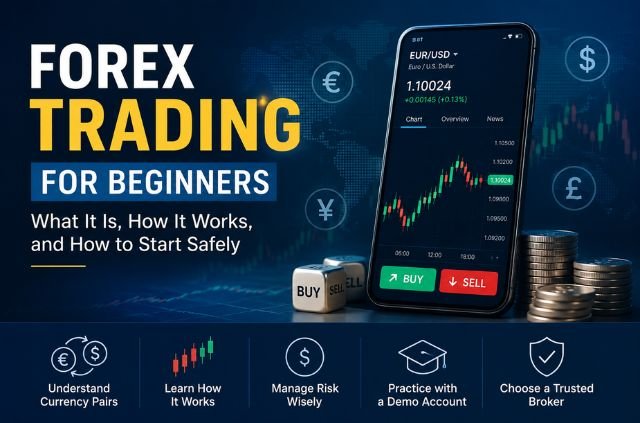
Forex trading is usually conducted through a broker or other trading provider. The basic process is as follows:
1. You select a currency pair, such as EUR/USD.
2.You decide whether you expect the pair to rise or fall.
3.You choose a position size and review the spread, margin requirement and other costs.
4.You place an order through the provider’s platform.
5.You manage the position using tools such as a stop-loss or take-profit order, where available and appropriate.
6.You close the position. Your result is the price movement multiplied by the position size, minus spreads, commissions, financing and any other applicable charges.
A simple example helps. Suppose EUR/USD is quoted at 1.1000 and you buy. If the pair later rises, the trade may produce a gross gain; if it falls, the trade may produce a gross loss. The actual result also depends on the number of units traded and the provider’s terms. A beginner should never judge a trade solely by its percentage return, because leverage can make a small market movement produce a large change in account equity.
Currency pairs: majors, minors and exotics
Currency pairs are commonly grouped into three categories. Definitions and available pairs can vary slightly between providers.
| Category | Examples | Typical characteristics |
| Major pairs | EUR/USD, USD/JPY, GBP/USD, USD/CHF, AUD/USD, USD/CAD, NZD/USD | Usually high trading activity and relatively lower spreads, though costs can widen during volatile or illiquid conditions. |
| Minor or cross pairs | EUR/GBP, EUR/JPY, GBP/JPY | Do not include the US dollar. Their liquidity and volatility vary by pair and market conditions. |
| Exotic pairs | USD/TRY, USD/ZAR, EUR/TRY | Combine a major currency with an emerging-market currency. They may have wider spreads and greater liquidity or political risk. |
For many beginners, studying one or two liquid pairs is more manageable than trying to follow dozens of markets. “Most profitable pair” is not a reliable concept: no currency pair guarantees a profit, and a pair that suits one strategy or time zone may not suit another.
What are pips, spreads and lots?
A pip is a commonly used unit for expressing a small movement in a currency pair. For many pairs, one pip is 0.0001; for many Japanese-yen pairs, one pip is 0.01. Some platforms display fractional pips, sometimes called pipettes. Always check the provider’s contract specifications rather than assuming the convention.
The spread is the difference between the bid price and the ask price. If EUR/USD is quoted at 1.1000 bid and 1.1002 ask, the displayed spread is two pips. The spread is one of the costs of entering and exiting a position. It may change with market conditions, news, trading hours and the type of account.
A lot describes the size of a forex position. Providers may offer standard, mini or micro lots, but the exact units and minimum trade size vary. Before placing an order, confirm the notional value, pip value, minimum size and margin requirement in the provider’s product documentation.
What is leverage and why is it risky?
Leverage allows a trader to control a position whose notional value is larger than the money set aside as margin. It can increase the market exposure generated by a given amount of capital. It also magnifies losses, and losses can accumulate quickly when a position is too large for the account.
Margin is the collateral required to open or maintain a leveraged position. A margin call or automatic close-out can occur when the account no longer meets the provider’s requirements. The precise rules differ by jurisdiction, product and provider.
Consider a simplified, non-predictive illustration. If a trader uses $1,000 of margin to control a $50,000 position, a 1% adverse move in the position represents a $500 gross loss before costs. That is 50% of the margin used. This example demonstrates exposure; it is not a suggested position size or expected outcome.
Regulation can limit leverage for retail clients in some jurisdictions. For example, the UK FCA’s CFD rules include leverage restrictions and require prominent risk warnings for retail clients. Rules differ internationally, and the protections available to a client depend on the entity providing the service and the client’s jurisdiction. Do not assume that a high leverage ratio is an advantage.
What are the main risks of forex trading?
The most important risk is that the market can move against you. Other risks include the following:
| Risk | What it means for a beginner |
| Leverage risk | A relatively small price movement can produce a large gain or loss in relation to the money committed. |
| Market and gap risk | Prices can move rapidly around economic announcements or when markets reopen, potentially causing execution at a worse price than expected. |
| Spread and liquidity risk | Spreads may widen and orders may be harder or more expensive to execute during volatile or thin markets. |
| Counterparty risk | You rely on the provider to execute, hold and settle trades according to its terms and regulatory obligations. |
| Financing risk | Positions held overnight may incur financing or swap charges that affect the result. |
| Behavioural risk | Fear, greed, overconfidence and attempts to recover losses can lead to poor decisions. |
| Currency and operational risk | Deposits, withdrawals, technology failures and account-currency conversion can affect the experience and outcome. |
The US Commodity Futures Trading Commission warns that retail forex customers should understand the dealer relationship, leverage and the possibility of losing money before trading. A responsible beginner’s plan starts with understanding these risks, not with searching for a guaranteed strategy.
How to manage risk as a beginner
Risk management cannot make a losing strategy profitable, but it can help prevent one trade from causing disproportionate damage. Before opening a position, decide how much money you can afford to lose and how the trade fits within your overall financial situation. Never use rent, emergency savings, borrowed money or funds needed for essential expenses.
Many traders use a pre-defined maximum loss per trade, a stop-loss order or a maximum total exposure. These are planning tools, not guarantees: a stop order may execute at a different price during fast markets, and a provider may apply specific rules or limitations. Avoid increasing position size after a loss simply to recover it, and keep a written record of the reason for each trade, the planned exit and the actual result.
If you do not understand the product’s margin, close-out, negative-balance, execution and financing rules, do not trade it with real money yet. Read the provider’s legal documents and risk disclosure in full.
What is a forex demo account?
A demo account uses simulated funds to let you practise on a trading platform. It can help a beginner learn how to place orders, read quotes, calculate position size and test a process without immediately risking real capital.
A demo account is not the same as live trading. It may not reproduce emotional pressure, slippage, liquidity conditions, financing costs or execution behaviour perfectly. Treat demo results as practice evidence, not as proof that a strategy will make money. Move to live trading only if you understand the risks and can afford a complete loss of the amount deposited.
How to choose a forex broker or trading provider
Before opening an account, verify the provider rather than relying only on advertising, social-media recommendations or a search ranking. Use the regulator’s official register where one exists, and make sure the legal entity in the register is the same entity named in the account agreement.
Read: Best Forex Brokers
Review the following points:
• Which company will be your contractual counterparty, and which regulator supervises it?
• Is forex offered as spot forex, a CFD or another product, and what protections apply?
• What are the spread, commission, financing, conversion, inactivity and withdrawal costs?
• What leverage, margin-call and automatic close-out rules apply to retail clients?
• How are client funds held, and what compensation or dispute-resolution arrangements exist?
• Are there restrictions on residents of your country?
• Can you read the product disclosure, client agreement and risk warning before depositing money?
• Does the provider publish the percentage of retail client accounts that lose money where required?
A secure website or polished app is not enough to establish that a provider is suitable. If a firm pressures you to deposit immediately, promises guaranteed returns or asks you to recruit others, treat that as a serious warning sign.
A sensible beginner workflow
A practical learning process is more useful than a promise of quick profits.
Read: Investing in Forex for Beginners
1. Learn the basic vocabulary
Understand currency pairs, bid and ask, pips, spread, margin, leverage, stop-loss, take-profit, financing and position size. You should be able to explain how a trade can lose money before placing one.
2. Choose one market and one simple process
Start by observing a small number of liquid pairs and record what moves them, such as interest-rate decisions, inflation data, employment reports and geopolitical events. You do not need to trade every market or every day.
3. Practise order mechanics
Use a demo account to learn how market, limit and stop orders work. Check how the platform displays margin, pip value, open profit and loss, financing and transaction costs.
4. Write rules before risking money
Define when you will trade, how you will select a setup, where the trade is invalidated, how you will size the position and when you will stop trading for the day or week. Rules should be written before the market moves, not invented under pressure.
5. Review process, not just profit
Keep a journal containing the setup, entry, exit, position size, costs, market conditions and whether you followed your rules. A profitable trade can still be poorly executed, and a losing trade can still follow a sound process.
6. Start small, if you decide to trade live
Use only money you can afford to lose. Start with the lowest practical exposure, avoid unnecessary leverage and understand that past demo or historical performance does not predict future results.
What is the best time to trade forex?
Forex trading hours depend on the market and provider, but activity generally changes as major financial centres open and close. Periods when major centres overlap may have greater activity, while holidays, late-week sessions and major announcements can produce different liquidity and volatility conditions.
There is no universally best time to trade. The appropriate time depends on the pair, strategy, time zone, costs and risk tolerance. Check the provider’s current trading schedule and economic calendar, and remember that high volatility creates both opportunity and risk.
Common beginner mistakes
Beginners often focus on finding a “winning” indicator while ignoring position size and costs. Other common mistakes include using too much leverage, trading during important announcements without understanding the risk, moving a stop-loss farther away to avoid taking a loss, opening too many correlated positions and treating a demo account as evidence of guaranteed live performance.
Another mistake is confusing education with a recommendation. A tutorial can explain how a tool works without saying that a particular pair, trade or provider is appropriate for you. If you are unsure whether leveraged trading fits your circumstances, seek independent advice from an appropriately qualified professional.
Read: MetaTrader 4 vs 5
Frequently asked questions
Can beginners make money trading forex?
Some people make profits, but many also lose money. No outcome is guaranteed, and early success may reflect favourable market conditions or chance rather than a repeatable skill. Focus first on understanding the product, managing exposure and following a documented process.
How much money do I need to start forex trading?
There is no universal minimum that makes trading safe. Providers set their own minimum deposits and trade sizes, while the amount appropriate for one person may be unsuitable for another. The key question is not how little you can deposit, but whether you can afford to lose the money and understand the full exposure created by the trade.
Is forex trading the same as investing?
Forex trading usually involves taking a view on exchange-rate movements, often over a shorter period and sometimes with leverage. The word “investing” can imply a different time horizon and risk profile. The product and account terms matter more than the label.
Should I use a demo account first?
A demo account is a sensible way to learn platform mechanics and test a process, but it cannot reproduce every aspect of live trading. Use it for practice, not as proof of future returns.
What is the safest forex strategy for a beginner?
There is no strategy that is universally safe or guaranteed to work. A beginner should prioritise limited exposure, clear rules, realistic expectations, a trading journal and a full understanding of leverage and costs over the search for a “secret” strategy.
Can I trade forex on a phone?
Many providers offer mobile platforms, but convenience does not reduce market risk. Before trading on a phone, confirm that you can review costs, margin, order type and risk controls clearly. Avoid making impulsive trades simply because the market is always accessible.
Forex trading is the exchange of one currency for another, usually through a broker or trading provider. To understand it properly, learn how currency pairs, pips, spreads, position size, leverage and margin interact. Then practise the mechanics, verify the provider’s regulatory status, create risk rules and use only money you can afford to lose.
The goal of beginner education should not be to promise fast profits. It should be to help you decide whether leveraged currency trading is suitable for you and, if you continue, to approach the market with realistic expectations and disciplined risk control.
Risk warning: Forex and CFD trading involve significant risk. Leverage can magnify both profits and losses, and you may lose more than you expect depending on the product, account terms and applicable protections. This educational article is not investment advice. Make sure you understand the product, check whether it is available and lawful in your jurisdiction, and consider seeking independent professional advice before trading with real money.
Related Pages: Forex Trading for Beginners in Malaysia