The global currency markets in April 2026 are no longer just a battle of interest rate percentages. While the traditional rate war between the US Federal Reserve and the European Central Bank remains the foundation of price action, a third, more volatile player has entered the arena: Energy.
For traders navigating the EUR/USD pair this month, the divergence between Washington and Frankfurt has reached a breaking point. As the Federal Reserve maintains a higher for longer stance supported by a resilient US economy, the ECB finds itself backed into a corner by soaring energy costs and the looming shadow of stagflation. To trade this environment successfully, you must look beyond the charts and understand the geopolitical mechanics forcing this policy pivot.
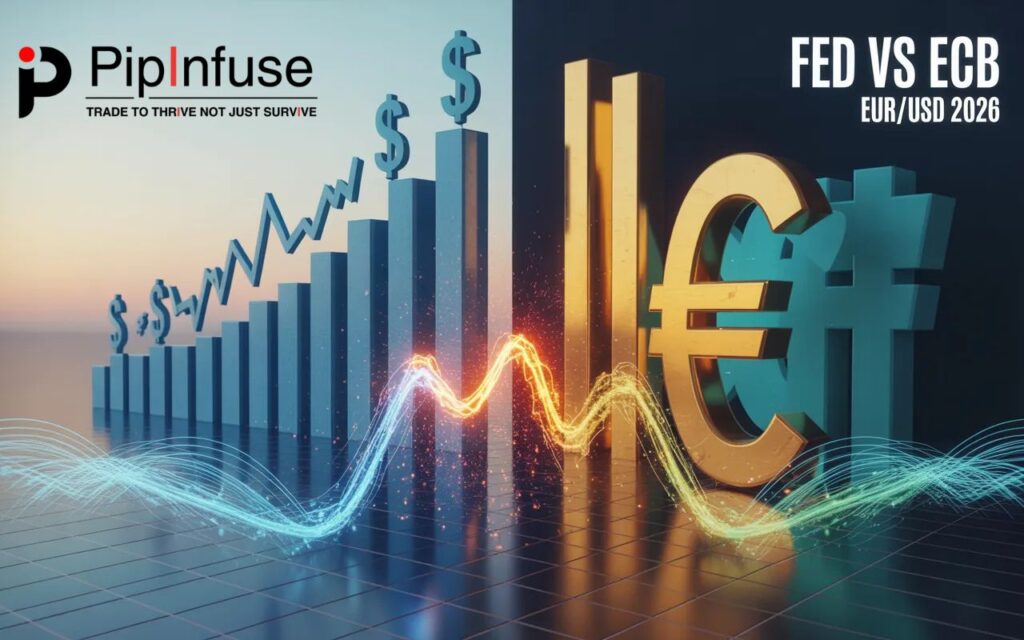
The Fed’s Resilience vs. The ECB’s Energy Trap
The core driver of the current EUR/USD weakness is the stark difference in how each central bank handles inflation. In the United States, the Fed has the luxury of a robust labor market and domestic energy independence. This allows Jerome Powell to keep rates at 3.50-3.75% without immediately triggering a systemic collapse.
In contrast, Christine Lagarde and the ECB are facing what we call the Energy Trap. Because Europe remains a net importer of energy, the recent volatility in the Middle East and the Strait of Hormuz has sent Eurozone inflation higher.
If you are looking for an edge in these fast moving markets, our professional Forex Trading and Investment management consultancy provides the daily technical flashes needed to stay ahead of the curve.
This is bad inflation, it isn’t driven by a booming economy, but by rising costs. If the ECB hikes rates to fight this inflation, they risk crushing an already fragile European recovery. If they cut rates to support growth, the Euro weakens further, making imported energy even more expensive. This policy divergence is the primary reason why we are seeing the EUR/USD test critical support levels near 1.1500.
Why the Rate War is Now an Inflation War
In 2025, the market was obsessed with the timing of the first rate cut. In April 2026, the focus has shifted to the Terminal Rate and the Inflation Floor.
The Fed is currently battling a sticky inflation floor of 3%. With the US economy still adding jobs, there is very little pressure on the Fed to pivot toward lower rates. This creates a Dollar Vacuum, where capital flows out of lower yielding currencies and into the USD.
For the Euro, the situation is compounded by the structural weaknesses in Germany’s industrial sector. High energy prices have made German manufacturing less competitive, leading to a trade balance shift that fundamentally devalues the Euro. When you combine a strong, high yield Dollar with a weak, energy dependent Euro, the path of least resistance for EUR/USD is consistently lower.
Technical Analysis : The 1.1500 Battlefield
From a practitioner’s perspective, the technical setup on the EUR/USD reflects this fundamental tension. We have seen a clear Head and Shoulders pattern forming on the weekly chart, with the neckline sitting right at the 1.1600 handle. The breakdown below this level last week was a significant signal for trend followers.
As we move through April, the 1.1500 level is the psychological line in the sand. A sustained break below this could open the door for a move toward 1.1200, or even the dreaded parity levels last seen during the 2022 energy crisis.
However, as a risk-first trader, you must be wary of intervention spikes. The ECB is well aware that a weak Euro fuels inflation. If the move becomes too disorderly, expect verbal interventions or sudden policy shifts that can cause 100 pip short squeezes in minutes.
Risk Management in a Volatile Policy Regime
Trading the Fed vs. ECB divergence is not about calling the bottom. It is about managing exposure during the ride down. We advocate for a strict risk management strategy, especially during energy driven market cycles.
Volatility in April 2026 is significantly higher than the historical average. The Average True Range (ATR) on EUR/USD has spiked, meaning your stop losses need more breathing room. If you are using tight stops in this environment, you will likely be hunted by news driven whipsaws before the actual trend resumes.
The goal is always capital preservation. In a market where a single headline about a pipeline or a central bank leak can move the needle by 1%, your primary job is to ensure you are still in the game for the next high probability setup.
To prevent unnecessary losses during these news spikes, you must implement max drawdown control and the 2% rule to protect your equity.
Strategy : How to Trade the Divergence
For those looking to capitalize on this policy pivot, there are three specific strategies to consider:
- The Fade into Resistance: Look for relief rallies back toward the 1.1700 or 1.1750 zones to establish short positions. In a diverging market, these pullbacks are often just opportunities for institutional players to reload USD longs.
- Yield Spread Trading: Monitor the 10 year Treasury vs. the 10 year Bund spread. As this gap widens in favor of the US, it provides a fundamental tailwind for your EUR/USD short trades.
- The Energy Hedge: Watch the price of Brent Crude. In the current 2026 regime, there is a strong inverse correlation between Oil prices and the Euro. If Oil spikes, the Euro usually dives.
Navigating these complex global shifts requires more than just a retail trading account. It requires institutional grade insights. We provide bespoke Forex trading solutions and risk management designed to help you transition from a retail mindset to a professional practitioner.
Building a Sustainable Trading Plan
Whether you are looking for advanced market analysis or technical infrastructure, our goal is to help you stop the bleeding and start building a sustainable trading career.
If you are wondering how this volatility fits into a broader long term strategy, check out our guide on building a Forex trading plan to see how to incorporate entries, exits, and journals into your daily routine.
Furthermore, choosing the right broker is critical during periods of high volatility. We provide access to vetted Forex Broker partners and liquidity providers to help you find platforms that offer the execution speeds required to trade central bank announcements without excessive slippage.
The Road Ahead for EUR/USD
The Fed vs. ECB war is far from over. As we look toward the second half of 2026, the focus will likely remain on whether the Eurozone can find an alternative to expensive energy imports or if the US economy finally begins to cool under the weight of high interest rates.
Until then, the divergence is your greatest edge. By staying risk first and focusing on the fundamental reality of the Energy Trap, you can navigate these record high market conditions with confidence.
About the Author
Bhagesh Nair is the Founder and Chief Market Analyst at PipInfuse. With over 12 years of professional trading experience navigating the global financial markets, Bhagesh specializes in a practitioner first approach that prioritizes risk management and capital preservation. Based in India, he provides deep dive analysis on currency pairs, precious metals, and energy markets for a global audience of over 22,000 followers. His trading philosophy is built on transparency, regulatory compliance, and the belief that mastering the trader’s mindset is the ultimate key to long term profitability.