The global financial landscape reached a critical juncture on April 8, 2026, when the US and Iran entered a tentative two week ceasefire. Brokered in Islamabad, this pause in hostilities has momentarily cooled a 39 day conflict that sent shockwaves through energy and currency markets. But, with the April 22 deadline approaching and the Strait of Hormuz remaining a focal point of tension, the big question for every trader is, What happens if the ceasefire fails?
For serious market participants, navigating this uncertainty requires more than just luck. It requires a practitioner first approach to risk management. As we watch the geopolitical clock tick down, understanding the specific forex scenarios is critical for protecting your capital and identifying high probability setups. Effectively managing risk during these periods of extreme uncertainty is the foundation of our Forex Trading and Investment Management consultancy, where we help traders protect their capital against sudden market shocks.
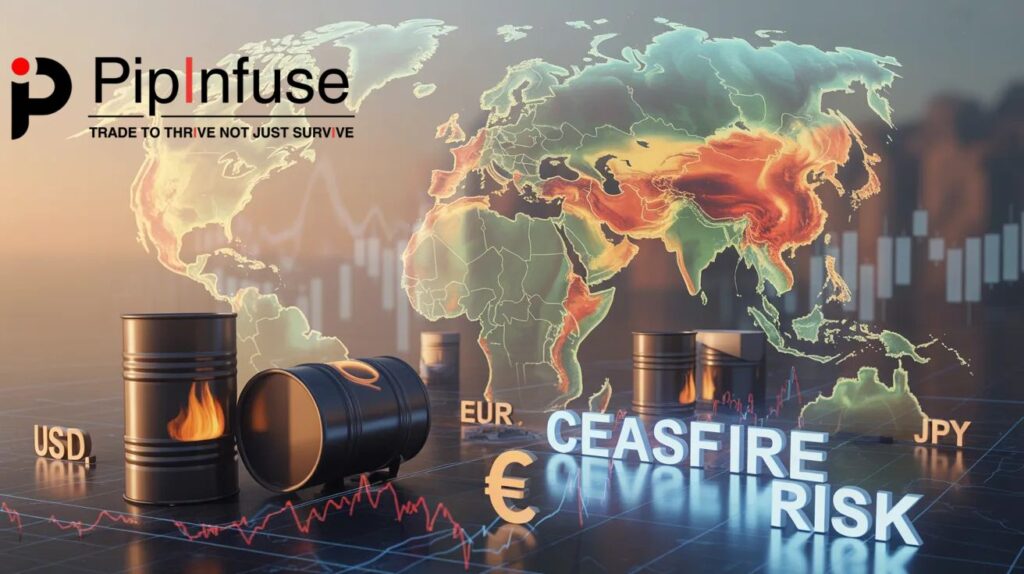
Geopolitical Risk and the Forex Market: The 2026 Landscape
Geopolitical risk is the ultimate driver of market volatility. Unlike economic data releases, which are scheduled, political collapses are often erratic and binary. In the current 2026 climate, the US–Iran relationship is the single most significant black swan variable. If negotiations in Pakistan stall, we could see a rapid transition from a risk on environment back to defensive positioning.
When trading through such high stakes events, your first priority should be choosing the right environment. At PipInfuse, we emphasize the importance of choosing a forex portfolio manager who understands these macroeconomic shifts and can pivot strategies in real time. Professional oversight ensures that your strategy adapts to headlines rather than getting caught in a liquidity trap.
The Total Collapse – A Return to Hostilities
If the ceasefire is terminated before the April 22 deadline, expect an immediate flight to safety. This is the classic safe haven play where the market abandons high yielding assets in favor of stability.
The Safe Haven Surge (USD, JPY, and CHF)
In this scenario, the US Dollar (USD) and the Japanese Yen (JPY) would likely see massive inflows. Historically, the Swiss Franc (CHF) also acts as a primary beneficiary. Traders should watch the USD/JPY pair closely, while both are safe havens, the USD often outperforms if the conflict threatens global energy supply, as the US has maintained high levels of energy independence.
Gold (XAU/USD) and Silver (XAG/USD) Breakouts
Metal markets are the first to react to failed diplomacy. We have already seen historic milestones earlier this year, with silver reaching 90 and gold hitting 5200. A return to war could push XAU/USD past previous resistance levels into uncharted territory. For those looking for high volatility plays, monitoring the gold to silver ratio during a ceasefire collapse is essential for timing entries.
The Strait of Hormuz Crisis – The Energy Play
The most significant threat in the US–Iran conflict is the disruption of the Strait of Hormuz. Since roughly 20% of the world’s petroleum passes through this chokepoint, any sign of a failed ceasefire will immediately impact oil correlated currencies.
The Rise of the Commodity Currencies (CAD and NOK)
The Canadian Dollar (CAD) and the Norwegian Krone (NOK) are heavily influenced by the price of Brent Crude. If the ceasefire fails and oil spikes toward the 120–140 range, these currencies will likely decouple from broader market sentiment and strengthen. This makes them ideal candidates for forex market volatility strategies.
The Vulnerability of Energy Importers (EUR and INR)
On the flip side, the Euro (EUR) and the Indian Rupee (INR) are highly sensitive to energy prices. A spike in oil acts as a tax on these economies, leading to potential bearish trends in EUR/USD and USD/INR. If you are looking for regulated forex brokers to trade these pairs, ensure they offer the deep liquidity required to handle the slippage often seen during oil shocks.
The Fragile Extension – Continued Uncertainty
The most likely scenario may not be total war or total peace, but a series of short term extensions. This limbo state creates a unique environment for range trading and scalp setups.
In a period of prolonged uncertainty, the market often sees fakeouts, sudden price movements based on unverified headlines that quickly mean revert. This is where technical analysis must be married to fundamental awareness. For beginners, this is a dangerous phase. We highly recommend reviewing our guide on how to build a trading watchlist to stay focused on high liquidity pairs like EUR/USD and GBP/USD rather than getting caught in the noise of exotics.
Strategic Risk Management: The PipInfuse Method
At PipInfuse, we believe that trading is not about predicting the future, but about being prepared for every possible version of it. Whether the ceasefire holds or fails, your trading plan must include:
- Guaranteed Stop-Losses: In a geopolitical crisis, normal stops can be skipped due to price gaps. Use guaranteed stops to lock in your maximum risk.
- Reduced Leverage: High volatility is a double edged sword. Reducing your position size allows you to stay in the trade longer without being stopped out by temporary whipsaw movements.
- Diversification: Do not put all your capital into a single war trade. Balance your portfolio with uncorrelated assets.
For those who prefer a hands off approach to these complex markets, exploring our professional Forex trading and investment solutions can provide the institutional grade risk management needed to weather the storm.
About the Author
Bhagesh Nair is the Founder and Chief Market Analyst at PipInfuse, an investment consultancy dedicated to risk first strategies and regulatory excellence. With over 12 years of professional experience in global financial markets, Bhagesh has built a reputation for demystifying complex macroeconomic events and providing actionable insights for both retail and institutional investors. He specializes in high stakes market analysis, and his philosophy centers on capital preservation and helping traders navigate the complexities of international jurisdictions (including FCA, ASIC, CySEC, and FSCA) with confidence and transparency.