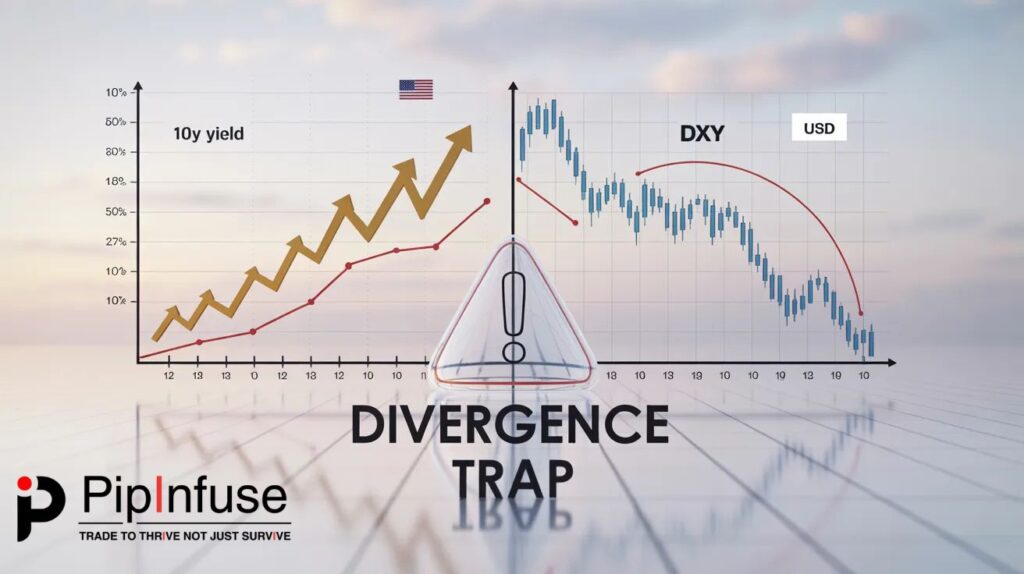
For over a decade, the playbook for global forex traders was etched in stone: higher yields equal a stronger currency. In the world of G10 macro trading, capital flows toward the highest risk adjusted return. However, as we navigate the mid point of 2026, a structural shift has occurred that is leaving retail traders trapped in losing positions. Despite US 10 year Treasury yields surging toward the 4.5% mark, the US Dollar Index (DXY) is stalling, and in some sessions, actively retreating.
In my 12 years of navigating global financial markets, I have seen these correlations break only during periods of immense systemic transition. We are currently witnessing a Yield Trap a phenomenon where rising interest rates are no longer a signal of economic strength, but rather a risk premium for fiscal instability. For those looking for bespoke Forex Trading and investment solutions in navigating these volatile waters, understanding this divergence is the difference between capital preservation and account liquidation.
The Broken Correlation: Real Yields vs. Fiscal Reality
The traditional relationship between bond yields and currency value relies on the assumption of growth driven inflation. When an economy grows, the central bank raises rates to cool it down, making the currency more attractive to international investors.
However, in 2026, the driver has shifted. We are now operating under a regime of Fiscal Dominance. With the US deficit hitting a staggering $1.9 trillion, the Treasury is forced to auction massive amounts of debt. When the supply of bonds outpaces global demand, yields must rise to attract buyers. But here is the catch: if investors are buying bonds because of high supply and fiscal risk rather than economic growth, they often sell the currency to hedge against the long term inflationary impact of that debt.
Read: Weakest Currencies in the World
This is the Yield Trap. The high interest rate is effectively a Sovereign Risk Premium. Institutional desks in Europe, the GCC, and Africa are increasingly looking at debt to GDP ratios as a more reliable indicator than the Fed’s dot plot. To truly master this environment, traders must learn to distinguish between nominal yields and real, inflation adjusted returns.
How Institutional Money is Front Running the $1.9 Trillion Deficit
While retail sentiment often lags behind the news, institutional money moves on expectations of expectations. Smart money is currently analyzing the Term Premium, the extra compensation investors demand for holding long term debt.
When the term premium rises alongside a weakening currency, it signals that the market is worried about the sustainability of a country’s balance sheet. This is why we are seeing a disconnect in major pairs. As the US Treasury continues to flood the market with paper, global reserve managers are quietly diversifying.
At PipInfuse, we emphasize a risk first approach. Whether you are a retail trader or looking for institutional grade options through our network of regulated forex brokers, understanding how liquidity flows from the Treasury to the FX spot market is essential. The Smart Money isn’t buying the Dollar at these levels, they are watching for the moment when the yield spike actually becomes a signal of systemic stress.
Trade Opportunities in EURUSD, GBPUSD, and Gold
The breakdown of the Dollar Yield correlation has created a unique Butterfly Effect across global markets. Because the Dollar is no longer tracking yields higher, several core assets have broken out of their traditional ranges.
The Resurgence of Gold (XAUUSD)
Traditionally, high yields are the enemy of Gold because Gold pays no interest. Yet, in 2026, we are seeing Gold trade at historic highs despite 4.5% Treasury rates. This is the ultimate confirmation of the Yield Trap. Gold is acting as a barometer of fiscal health. If the Dollar cannot rally when yields are high, investors flee to hard assets.
EURUSD and the Eurozone Resilience
Despite the ECB’s own challenges, the Euro has found a floor. Institutional investors in London and Paris are noticing that Eurozone debt, while slower growing, does not carry the same immediate issuance shock as the US Treasury market. This makes GBPUSD trend following strategies and EURUSD long positions a viable contrarian play against a heavy US Dollar.
Commodity Currencies in the GCC and Africa
For our followers in the GCC and Africa, the focus remains on the Petrodollar shift. If the US Dollar weakens while yields are high, commodity linked currencies often see a lag in strength followed by a sharp breakout. This creates a high probability window for traders who can stay patient.
The PipInfuse Framework: 3 Metrics to Watch Before Your Next Trade
To avoid falling into the Yield Trap, you must move beyond basic technical analysis and incorporate macro intelligence into your routine. Here are the three metrics we use at PipInfuse to validate a move:
- The Yield Currency Divergence: If 10Y yields rise by 10 basis points but the DXY remains flat or falls, do not buy the Dollar. This is a signal of Fiscal Risk rather than Growth Strength.
- Auction Quality: Monitor the Bid to Cover ratios of US Treasury auctions. A weak auction (low ratio) usually leads to higher yields and a weaker currency, the heart of the trap.
- Real Yield Spreads: Always look at the yield minus the inflation rate. If US inflation is sticky while yields rise, the Real Yield may actually be shrinking, removing the incentive for capital inflows.
By applying these metrics, you can transition from a signal chaser to a macro intelligent practitioner. Our goal at PipInfuse is to provide the transparency and transparency first policy required to navigate these complex cycles. To understand more about our methodology and how we protect capital, you can explore our professional portfolio metrics and our specialized approach to market analysis.
Trading the New Macro Reality
The 2026 Forex market is not for the faint of heart. The Yield Trap is a reminder that markets are living organisms that evolve. The strategies that worked in 2022 and 2024, namely, blindly buying the currency with the highest interest rate, are being punished by a market that is increasingly focused on fiscal health and debt sustainability.
Success in this environment requires a blend of technical precision and macro economic foresight. By focusing on capital preservation and understanding the second order effects of bond market volatility, you can position yourself on the right side of the institutional flow. Remember, in a world of broken correlations, the trader with the best framework, not the fastest signal wins.
About the Author:
Bhagesh Nair is the Founder and Chief Market Analyst of PipInfuse, an elite forex trading and investment management consultancy. With over 12 years of experience navigating global financial cycles, Bhagesh specializes in risk first macro strategies and institutional grade market analysis. Under his leadership, PipInfuse has grown into a trusted authority for traders in Europe, the GCC, and Africa, known for its commitment to regulatory transparency and capital preservation.
Related Pages: Trading and Investment Services, Forex Trading Solutions, Forex Trading and Investment Consultancy